We’ve learned charting –anticipating what we plan– and logging — documenting our actions — brings together the three cognitive positions necessary to a decision: anticipation, actualization, and review.
And we know, if we want to achieve something, we have to align three states: anticipation, actualization, and review. The less reward there is in anticipation and actualization, the more we have to hold a powerful vision of a satisfying aftermath.
In our work, we use a simple table to help us keep the three cognitive positions salient.
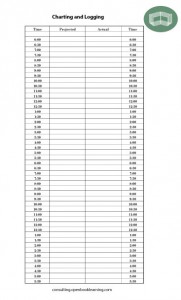
We use column one to chart our expectations for the following day. Often this reveals just how many promises we’ve made to ourselves. So many promises; so little time.
Then we begin to see how much our day is spent eating, commuting, sitting in meetings.
Most important, it makes visible the boundaries of the 24-hour wall. No one gets more time. We can make the most of our 24 hours by working during meals, using the commute to walk or bike and thereby get exercise without taking time out for the gym., take a train, a bus, or engage a driver so we can work during the commute. However, at some point, we hit the wall. We can pack a day with so much and no more.
And we usually run of cognitive energy before that. Just as nearly all of us run of out miles we can run before we run out of day, we also run out of decisions we can make, problems we can solve, negotiations we can conduct, words we can read before we run out of day.
In either case, the better we understand the boundaries of our day, the better we’ll keep the commitments we make.
We chart and log a few samples of single days in order to make us conscious of our quotidian boundaries.
We never encourage people to try to chart and log every single day. If you’re struggling to fit in all your commitments, we would be amiss to add another to your daily load. Besides, it’s sufficient to sample a day here and there to get an illuminating view.